Accrued expenses fail at the intersection of timing, judgment, and weak documentation.
Invoice receipt date does not determine expense recognition.
Service period drives accrual decisions, not vendor billing behavior.
QuickBooks requires compensating controls for accruals.
Clear decision rules and evidence reduce audit adjustments dramatically.

Executive Summary
Accrued expenses exist to solve a timing problem. Services are received today. Invoices arrive later. Accounting must bridge that gap.
In QuickBooks-heavy environments, this bridge is fragile. Month-end closes depend on memory, inbox checks, and ad hoc journal entries. Teams debate whether to accrue based on invoice receipt dates instead of service periods. Documentation lives in emails or spreadsheets, disconnected from the general ledger.
Auditors do not test intent. They test outcomes. Missed accruals, late reversals, and unsupported estimates are among the most common findings in SMB and mid-market audits.
This article provides a practical framework for designing and implementing comprehensive internal control procedures for accrued expenses. The focus is execution. Each control is illustrated with real-life scenarios that accountants and controllers face every month, especially around cutoff, invoice timing, and service periods.
1. Understanding Accrued Expenses: The Non-Negotiables
1.1 What an Accrued Expense Is
An accrued expense is a liability for goods or services already received but not yet invoiced or paid.
Three conditions must exist:
The service has been received.
The amount can be reasonably estimated.
The invoice is not recorded as of period end.
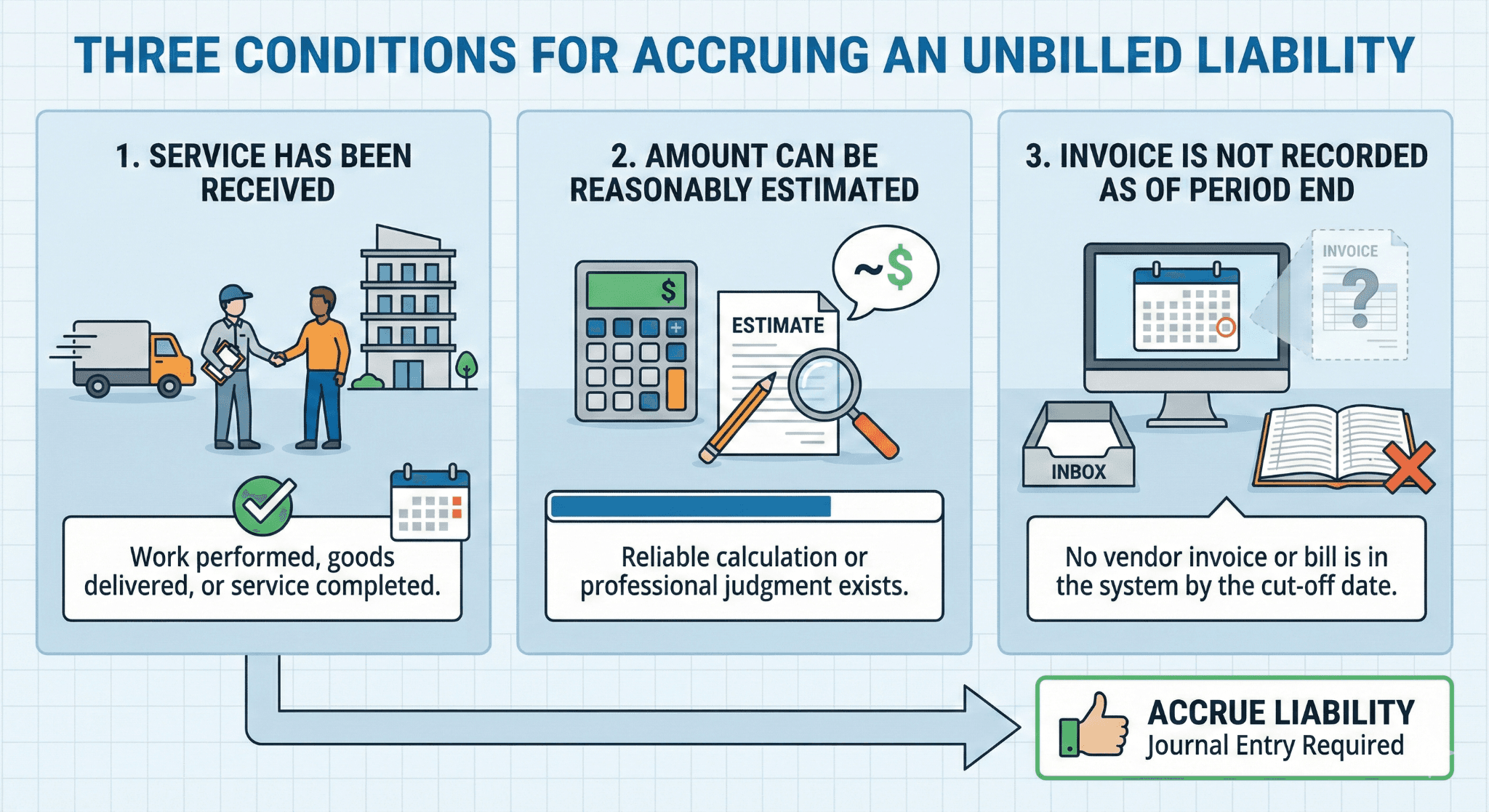
An accrued expense is a liability recorded on a company's balance sheet under U.S. Generally Accepted Accounting Principles (US GAAP) to reflect costs incurred during an accounting period for which payment has not yet been made. This concept is fundamental to the accrual basis of accounting and is required by the revenue recognition principle (ASC 606) and the expense recognition principle (matching principle), ensuring that expenses are reported in the same period as the revenues they helped generate.
Key US GAAP Requirements for Recognizing Accrued Expenses:
Definition of a Liability (FASB Concepts Statement No. 6): An accrued expense meets the definition of a liability, which is a probable future sacrifice of economic benefits arising from present obligations of a particular entity to transfer assets or provide services to other entities in the future as a result of past transactions or events. The obligation arises because the entity has received the service or benefit.
Expense Recognition (Matching Principle): The expense must be recognized in the period the goods or services were consumed or the economic benefit was received, regardless of when the invoice is received or cash is paid. This ensures the company's financial statements accurately reflect the true economic performance of the period.
Measurability: The amount of the expense must be reasonably estimable. While an exact invoice is not required, US GAAP requires that the amount recorded be based on the best available objective information, such as contract terms, historical patterns, or standard rates. If the amount cannot be reasonably estimated, the expense should not be accrued, and disclosure may be required if the potential liability is material.
Distinction from Accounts Payable: Under US GAAP, accrued expenses are distinct from Accounts Payable (A/P). Accrued expenses are liabilities recognized without a vendor invoice being processed, based on estimation. A/P represents liabilities for goods or services received where the vendor invoice has been received and approved for payment. Both are classified as current liabilities if payment is due within one year or the operating cycle, whichever is longer.

Journal Entry (Under US GAAP):
To recognize the accrued expense:
Date | Account | Debit | Credit |
Period End | Expense Account (e.g., Salaries Expense) | XXX | |
Accrued Liability (e.g., Accrued Wages Payable) | XXX | ||
To record the expense incurred but not yet paid |
When the actual payment is made or the invoice is received:
Date | Account | Debit | Credit |
Subsequent Period | Accrued Liability (to remove the obligation) | XXX | |
Cash or Accounts Payable | XXX | ||
To settle the previously accrued liability |
.
2. The Core Accrual Decision Framework
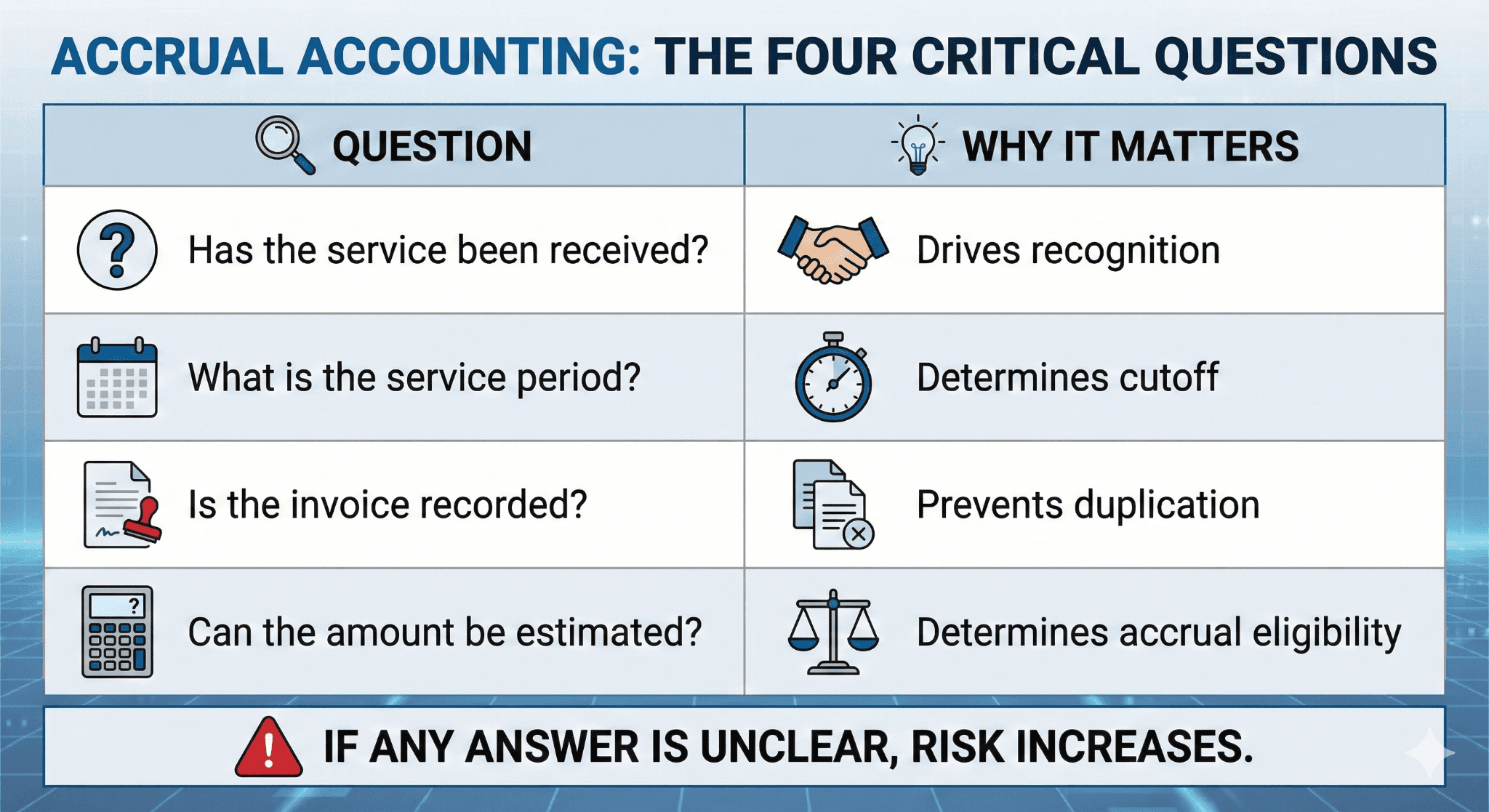
Before booking any accrual, the accountant must answer four questions.
Question | Why It Matters |
Has the service been received? | Drives recognition |
What is the service period? | Determines cutoff |
Is the invoice recorded? | Prevents duplication |
Can the amount be estimated? | Determines accrual eligibility |
If any answer is unclear, the risk increases.
3. Practical Case Studies: Invoice Timing and Month-End Cutoff
Case Study 1: Invoice Received Before Month-End, Service Extends Beyond
Scenario
Vendor invoice date: March 28
Invoice received: March 29
Service period: April 1 – April 30
Accounting period: March close
Common Mistake
Expense recorded in March because invoice was received before close.
Correct Treatment
Do not accrue. Do not expense. Record as prepaid or defer recognition.
Why
No service was received in March. Accrual criteria are not met.
Control Lesson
Invoice receipt date does not override service period.
Documentation Required
Invoice
Contract or service period confirmation
Accounting memo explaining deferral decision
Case Study 2: Invoice Received After Month-End, Service Fully in Prior Month
Scenario
Service period: March 1 – March 31
Invoice date: April 3
Invoice received: April 5
March close in progress
Correct Treatment
Accrue expense in March.
Journal Entry (March 31)
Debit: Expense
Credit: Accrued expenses
Reversal (April 1)
Debit: Accrued expenses
Credit: Expense
Why
Service was fully received in March. Invoice timing is irrelevant.
Documentation Required
Prior month contract or engagement letter
Estimation worksheet
Accrual JE support
Case Study 3: Invoice Received After Month-End, Partial Service Period
Scenario
Service period: March 15 – April 14
Invoice received: April 10
Total invoice: $3,000
Decision Required
Accrue only the portion related to March.
Calculation
March portion: 17 days
Total days: 31
Accrued amount: $1,645
Common Failure
Teams accrue full invoice or skip accrual entirely.
Control Requirement
Defined proration methodology documented in policy.
4. Service Period Ambiguity: Gray Areas That Break Controls
Case Study 4: Utilities with Estimated Usage
Scenario
Utility bill received April 12
Billing period: March 10 – April 9
Correct Accrual
Estimate March 10 – March 31 portion
Accrue based on prior usage trends
Documentation
Prior utility bills
Estimation logic
Calculation worksheet
Audit Expectation
Consistency over precision.
Case Study 5: Professional Fees Without Clear Time Sheets
Scenario
Legal firm invoice pending
Ongoing engagement
No time sheets received
Decision
Accrue based on engagement scope and historical billing.
Risk
Management bias if unsupported.
Mitigation
Engagement letter
Prior month invoices
Conservative estimation rule
5. When Not to Accrue: Over-Accrual Is Also a Control Failure
Case Study 6: Goods Not Yet Received
Scenario
Purchase order issued
No delivery as of month-end
No invoice received
Correct Treatment
Do not accrue.
Why
No service or goods received.
Common Error
Accruing based on PO alone.
Case Study 7: Invoice Recorded Before Close
Scenario
Invoice received March 31
Bill entered March 31
Payment pending
Correct Treatment
Do not accrue.
Why
Liability already recorded in accounts payable.
Control
Accrual checklist must confirm invoice posting status.
6. Accrual Documentation: What Auditors Actually Want
6.1 Minimum Accrual Support Package
Every accrual should have:
Document | Purpose |
Service evidence | Confirms receipt |
Calculation | Supports amount |
Policy reference | Consistency |
JE approval | Authorization |
Reversal link | Completeness |
Attachments must be stored in or referenced from QuickBooks.
7. Accrual Reversal and Clearing Controls in Practice
Case Study 8: Failure to Reverse Accrual
Scenario
March accrual booked
April invoice recorded
Accrual not reversed
Impact
Expense duplicated.
Control
Mandatory reversal entry dated first day of next period.
Case Study 9: Clearing Accrual Upon Invoice Receipt
Best Practice in QuickBooks
Record invoice to expense
Clear accrual via reversal
Tie invoice number in memo
Review Control
Monthly list of open accruals reviewed by controller.
8. Accrued Expense Rollforward: The Anchor Control
Case Study 10: Rollforward Prevents Material Misstatement
Scenario
Accrued expenses balance grew month over month
No rollforward performed
Control Added
Monthly rollforward showing:
Opening balance
New accruals
Reversals
Settlements
Outcome
$120,000 stale accrual identified before audit.
9. Operating Model: Who Does What
Role | Responsibility |
Bookkeeper | Data collection |
Accountant | Accrual calculation |
Controller | Review and approval |
Segregation of duties is required even in small teams.


Tool and Workflow Comparison
Method | Risk Level | Audit Outcome |
Memory-based accruals | High | Weak |
Checklist-driven accruals | Medium | Acceptable |
FinBoard.ai module | Low | Strong |
Risks and Mitigations
Risk | Mitigation |
Invoice timing confusion | Service-period rule |
Estimation bias | Standard formulas |
Missed reversals | Mandatory auto-JE |
Weak evidence | Documentation pack |
FAQ
Is invoice date ever relevant?
Only for AP aging, not expense recognition.
Can accruals be immaterial?
Yes, based on defined thresholds.
Are emails sufficient support?
Only if retained and referenced.
Do accruals need approval?
Yes. They are judgmental entries.
Should accruals reverse automatically?
Yes, unless settled before reversal.
Glossary
Accrued Expense: Liability for incurred costs not yet invoiced.
Service Period: Time during which benefit is received.
Cutoff: Correct period recognition.
Rollforward: Balance movement analysis.
Reversal: Entry negating prior accrual.