Employee benefit liabilities behave like short-term credit exposure.
Obligations arise before payment and require estimation.
QuickBooks Online records transactions, not expected obligations.
CECL-style thinking improves accrual accuracy, predictability, and audit outcomes.
This is not CECL compliance. It is CECL discipline applied to benefits.
Executive Summary
Most accounting teams treat employee benefits as a payroll byproduct. Payroll runs. Entries post. Vendors get paid. End of story. That approach works only when timing, headcount, and benefit structures remain static. The moment any of those variables change, benefit accounting becomes noisy, unpredictable, and difficult to defend.
US GAAP does not allow benefit obligations to float between periods based on convenience. Expenses must follow service periods. Liabilities must reflect obligations incurred but not yet settled. Estimation is not optional.
This is where a CECL-style mindset becomes useful.
CECL, at its core, is about recognizing expected outcomes early, using reasonable information available today. That same discipline applies directly to employee benefit liabilities. Benefits are earned before they are paid. The amount is often known approximately but not precisely. Timing differences introduce risk. Ignoring that risk creates distortions.
This article reframes employee benefit accounting using CECL principles. It explains how to identify benefit exposure, estimate expected obligations, update assumptions, and document judgments in a way that aligns with US GAAP and works in QuickBooks Online Online environments.
Why CECL Thinking Belongs in Benefit Accounting
CECL did not invent estimation. It formalized a mindset that good accountants already use.
The mindset asks:
What obligation exists today?
What do we reasonably expect to pay?
What information should influence that estimate?
How often should the estimate change?
Employee benefit liabilities meet all four criteria.
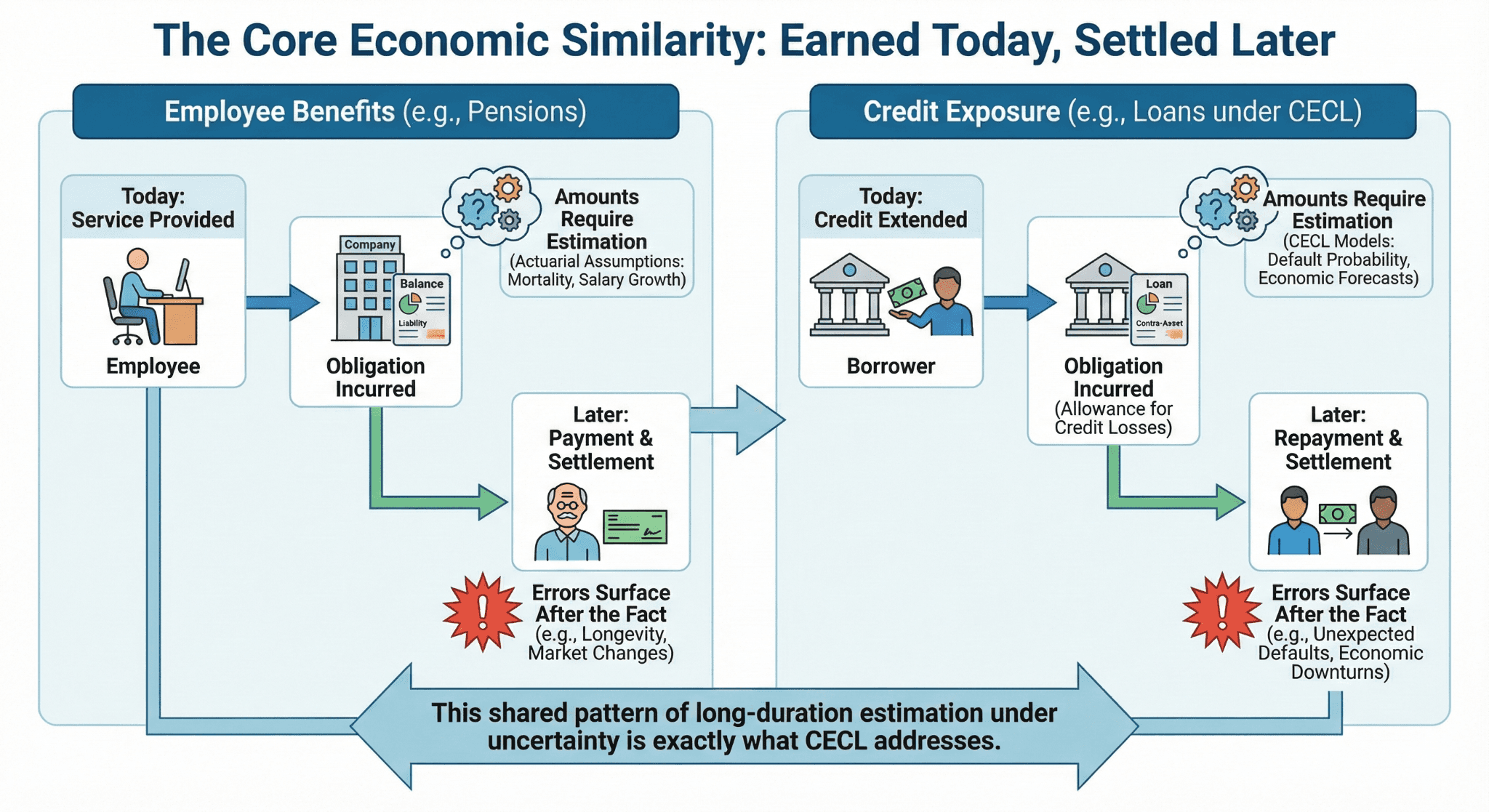
The Core Similarity: Earned Today, Settled Later
Employee benefits share the same economic structure as credit exposure.
Employees provide service today.
The company incurs an obligation today.
Payment happens later.
Amounts require estimation.
Errors surface after the fact.
This is exactly the pattern CECL addresses.
Traditional Benefit Accounting: The Incurred Model
Most QuickBooks Online users operate on an incurred-only model.
Characteristics:
Expense recorded on payroll date
Vendor bills expensed when paid
Accruals limited or nonexistent
Adjustments reactive, not planned

CECL-Style Benefit Accounting: The Expected Model
A CECL-style approach reframes the workflow.
Characteristics:
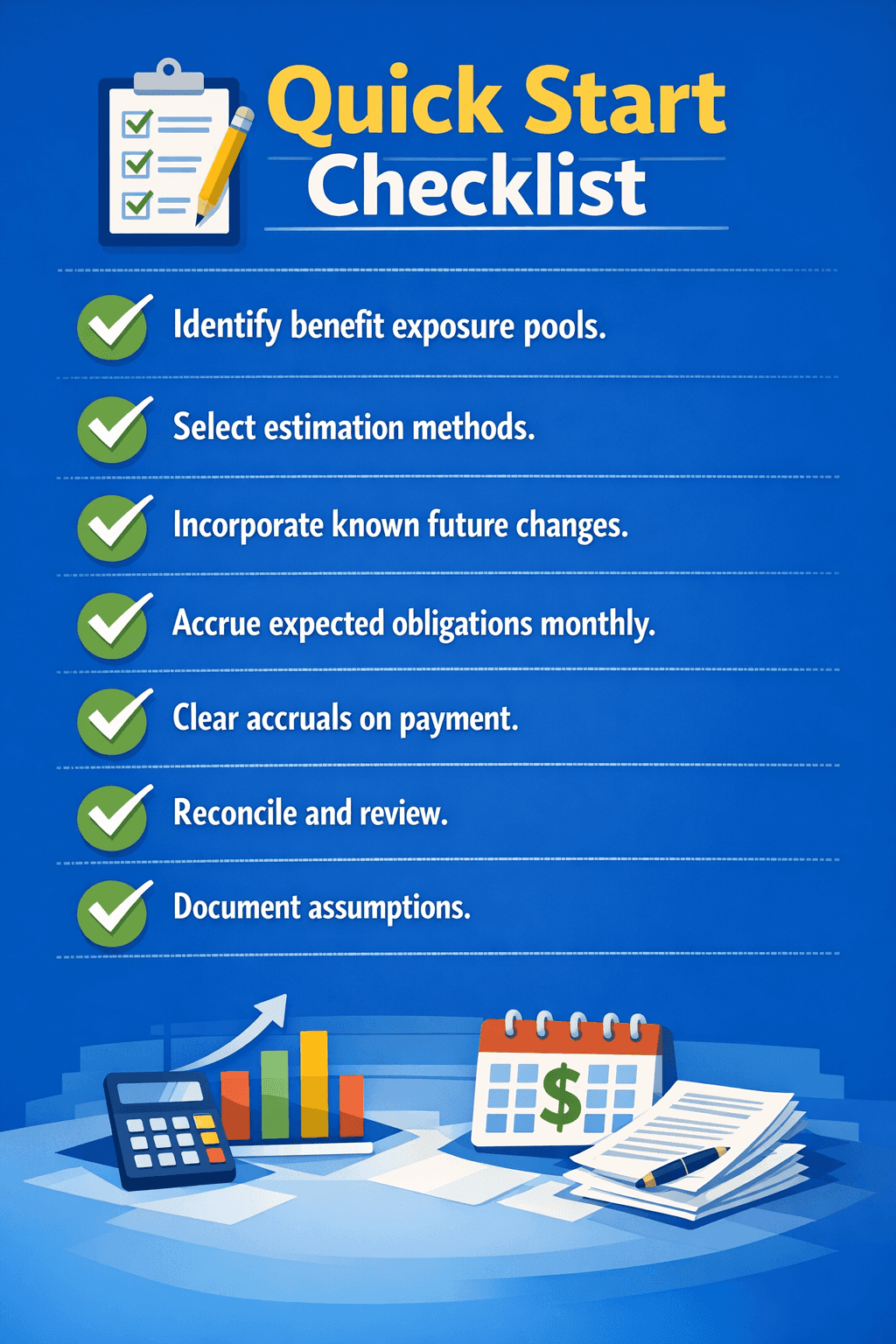
Identify benefit exposure continuously
Estimate employer obligation monthly
Recognize expense before payment
Update estimates as conditions change
Reconcile estimates to actuals
The difference is not accounting mechanics. It is timing discipline.
Mapping CECL Framework to Benefit Liabilities
CECL Component | Benefit Accounting Equivalent |
Financial asset | Earned benefit obligation |
Credit exposure | Employee service rendered |
Expected loss | Expected employer benefit cost |
Historical loss data | Prior benefit cost experience |
Current conditions | Headcount, payroll, plan terms |
Reasonable forecast | Hiring plans, benefit changes |
Allowance | Accrued benefit liability |
This mapping is not theoretical. It mirrors how auditors already think.
Identifying Benefit Exposure Pools
CECL requires segmentation. Benefits should be segmented too.
Common Benefit Exposure Pools
Health Insurance
Monthly premiums
Coverage-based
Often paid after coverage period
Retirement Match
Payroll-based
Earned when payroll is earned
Paid later, sometimes quarterly
Employer Payroll Taxes
Statutory
Accrue with wages
True-ups common
Life and Disability Insurance
Flat or tiered premiums
Coverage timing matters
Bonuses and Incentives
Service-based
Payment timing varies
Each pool has different estimation risk.
GAAP Foundation: What the Standards Actually Require
US GAAP does not require CECL for benefits. It does require:
Accrual accounting
Expense recognition when incurred
Reasonable estimation of liabilities
Consistent application of accounting policies
Relevant guidance includes:
ASC 710 (Compensation)
ASC 450 (Contingencies)
ASC 275 (Risks and uncertainties)
Together, they require recognition of obligations that are probable and reasonably estimable.
Employee benefits almost always meet that threshold.
Where Benefit Risk Actually Comes From
Benefit risk is not abstract. It is operational.
Primary drivers:
Payroll timing shifts
Mid-month hires and terminations
Waiting periods
Benefit elections changes
Vendor invoice delays
Manual overrides in payroll
Each introduces estimation error if not anticipated.
Case Scenario 1: Rapid Hiring and Under-Accrued Insurance
Company Profile
Marketing agency. 120 employees. QuickBooks Online Online Payroll.
Situation
Aggressive hiring over six months. Health insurance premiums billed monthly in arrears.
Traditional Treatment
Insurance expensed when bill paid.
Result
Monthly expenses lagged headcount growth. EBITDA looked inflated. Year-end audit proposed a large catch-up.
CECL-Style Fix
Estimated monthly employer insurance cost based on enrolled headcount at month-end. Accrued expected obligation regardless of invoice timing.
Outcome
Expenses aligned with service periods. Audit adjustment eliminated.
Case Scenario 2: Retirement Match Lag and Double Counting
Company Profile
Professional services firm. 80 employees.
Situation
Retirement match calculated with payroll but paid quarterly.
Problem
Payroll posted expense. Quarterly payment expensed again.
Root Cause
No liability tracking. Payment treated as new expense.
CECL-Style Fix
Payroll posted expense and liability. Quarterly payment cleared liability only.
Outcome
Eliminated duplicate expense. Clean liability rollforward.
Case Scenario 3: Headcount Reduction and Over-Accrued Benefits
Company Profile
SaaS startup. Workforce reduction mid-quarter.
Traditional Behavior
Continued accruing benefits based on prior headcount.
Issue
Over-accrued insurance and retirement benefits.
CECL-Style Update
Updated estimate based on reduced headcount and coverage end dates.
Outcome
Accruals reversed promptly. No surprise reversals later.
Estimation Techniques That Work in Practice
CECL does not require complexity. Benefits do not either.
Acceptable Estimation Methods
Per-employee monthly cost
Fixed premium per covered life
Percentage of payroll for retirement match
Blended historical average adjusted for forecast changes
What matters is consistency and rationale.
Incorporating Forward-Looking Information
CECL explicitly requires forward-looking consideration. Benefits should too.
Examples of reasonable forward-looking inputs:
Approved hiring plans
Known premium increases
Planned layoffs
Benefit plan changes
Contractual rate escalations
Ignoring known information is not conservative. It is inaccurate.
How This Works Month-End in QuickBooks Online
QuickBooks Online will not do this automatically. The workflow is manual but manageable.
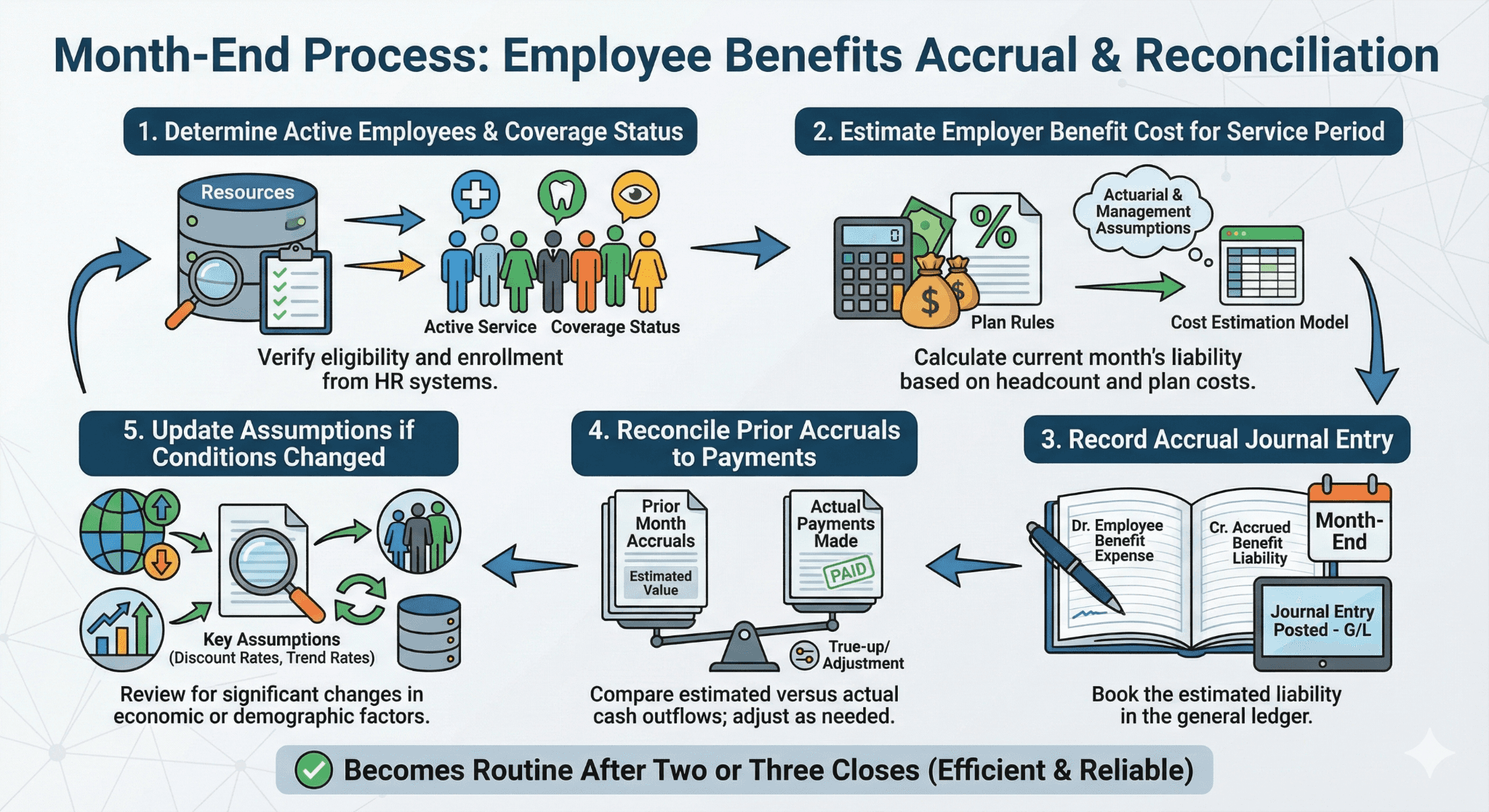
Month-End Process
Determine active employees and coverage status.
Estimate employer benefit cost for the service period.
Record accrual journal entry.
Reconcile prior accruals to payments.
Update assumptions if conditions changed.
This becomes routine after two or three closes.
Journal Entries Explained
Accrual Entry
Debit: Benefit Expense
Credit: Accrued Benefit Liability
Payment Entry
Debit: Accrued Benefit Liability
Credit: Cash or Accounts Payable
No expense on payment if already accrued.
Reconciliation: The Control That Makes This Work
Each benefit pool should reconcile monthly.
Reconciliation structure:
Opening liability
Plus current period accrual
Minus payments
Equals closing liability
Unexplained differences indicate process failure.
Documentation: Turning Judgment Into Defense
Auditors do not reject estimates. They reject undocumented estimates.
Document:
Estimation methodology
Data sources
Update triggers
Review and approval
This converts judgment into policy.
Case Scenario 4: Private Equity Due Diligence
Company Profile
PE-backed manufacturing firm.
Issue Identified in QoE
Benefit accruals inconsistent and undocumented.
Impact
Normalized EBITDA adjustment proposed.
Remediation
Implemented CECL-style benefit accrual framework with documentation.
Result
Adjustment removed. Valuation preserved.
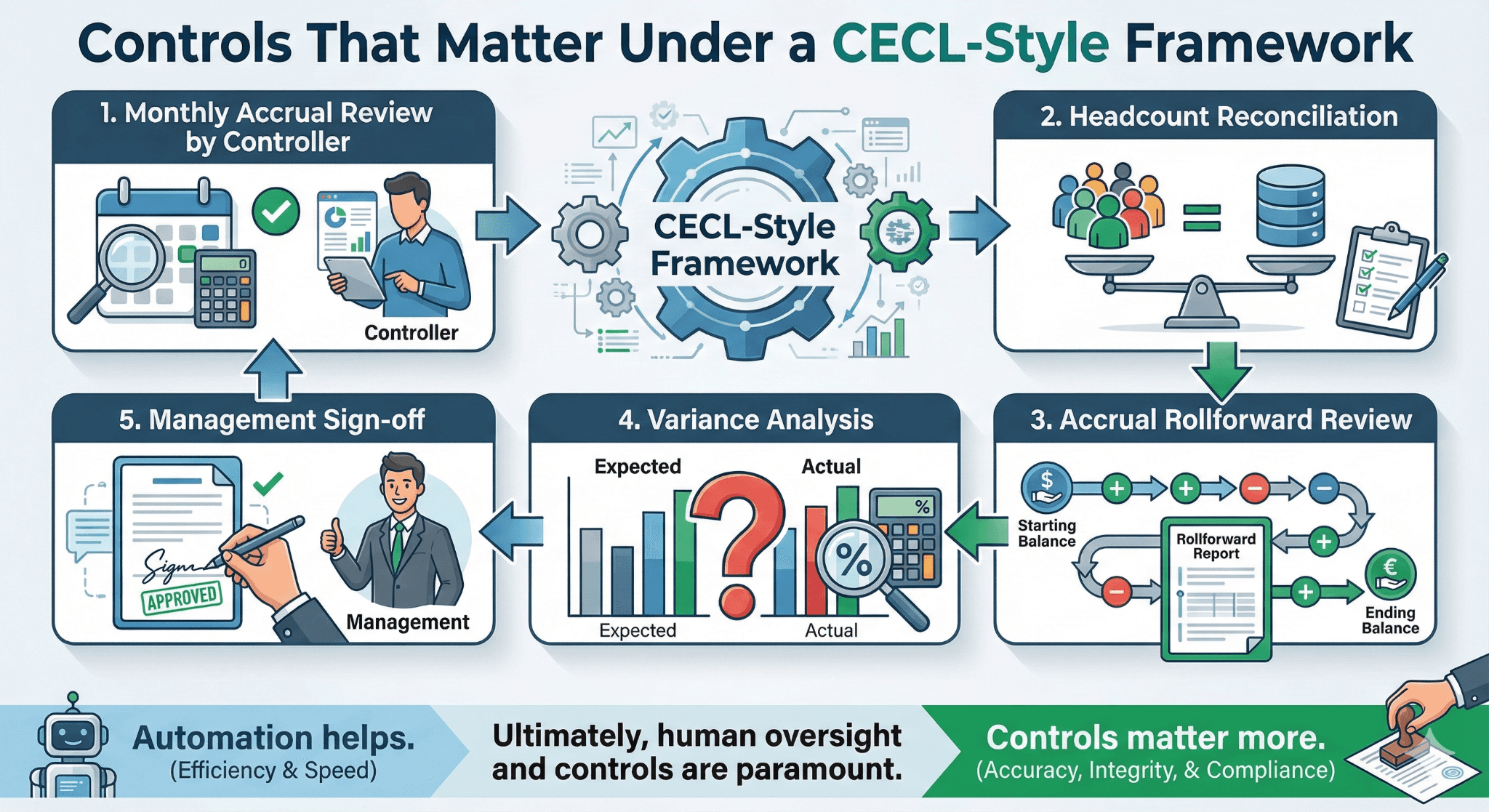
Controls That Matter Under a CECL-Style Framework
Key controls include:
Monthly accrual review by controller
Headcount reconciliation
Accrual rollforward review
Variance analysis
Management sign-off
Automation helps. Controls matter more.
Common Pushback and Practical Responses
“This is too complex.”
It replaces chaos with routine.
“Amounts are not material.”
Materiality changes quickly with growth.
“QuickBooks Online payroll already handles benefits.”
Payroll handles processing, not estimation.
Audit Perspective
Auditors increasingly expect:
Accrual methodology
Forward-looking consideration
Consistent application
Reconciliation support
They may not say “CECL,” but the logic is the same.
Tool Comparison: Incurred vs Expected
Approach | Predictability | Accuracy | Audit Risk |
Cash-based | Low | Low | High |
Incurred accrual | Medium | Medium | Medium |
CECL-style | High | High | Low |
When This Framework Is Most Valuable
Rapid growth or contraction
Material benefit costs
EBITDA-focused stakeholders
Recurring audits
Investor reporting
Stable, cash-basis entities feel less impact. Everyone else benefits.
Frequently Asked Questions
Is this required by GAAP?
The accrual is required. The mindset enables compliance.
Is this CECL compliance?
No. It is CECL-style reasoning.
Does this replace payroll accounting?
No. It complements payroll.
Can QuickBooks Online automate this?
Not fully. Judgment remains essential.
Will auditors support this?
Yes, when applied consistently and documented.
Glossary
Expected Obligation
Estimated benefit cost earned but unpaid.
Exposure Pool
Group of similar benefit liabilities.
Forward-Looking Adjustment
Estimate change based on known future conditions.
Accrued Benefit Liability
Balance sheet account representing expected obligation.