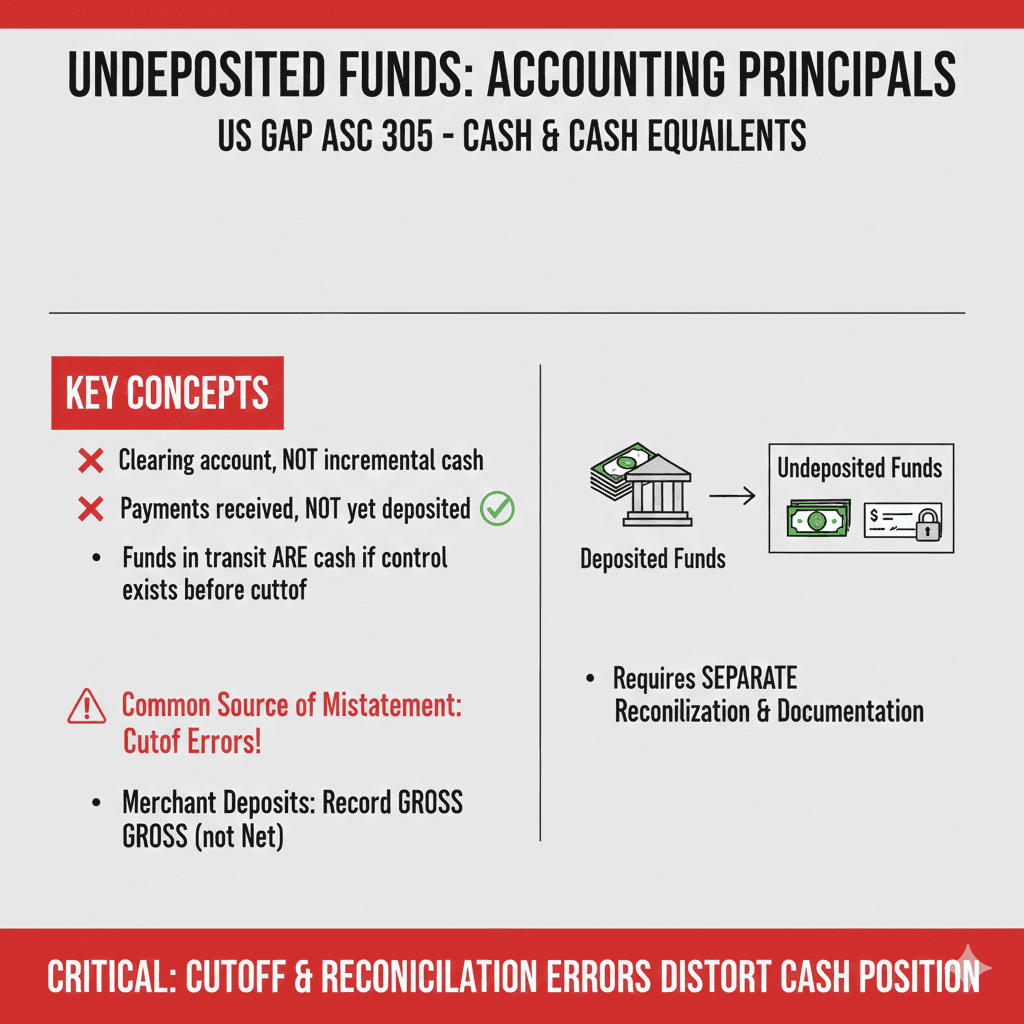
Undeposited Funds is a clearing account, not incremental cash. It represents payments received but not yet deposited into the bank.
Under US GAAP (ASC 305 – Cash and Cash Equivalents, Canonical), funds in transit are included in cash if the company has control before the reporting cutoff.
Month-end and year-end cutoff errors are the most common source of misstatement.
Merchant processor deposits must be recorded gross, not net of fees.
Undeposited Funds require its own reconciliation and documentation process, separate from the bank reconciliation.
Executive Summary
Undeposited Funds is one of the most operationally convenient yet conceptually misunderstood accounts in QuickBooks Online. It simplifies deposit grouping. However, from a US GAAP perspective, it introduces timing risk, reconciliation complexity, and internal control exposure. Many small and mid-market entities rely on bank feeds and assume the bank reconciliation alone ensures accuracy. That assumption is incorrect.
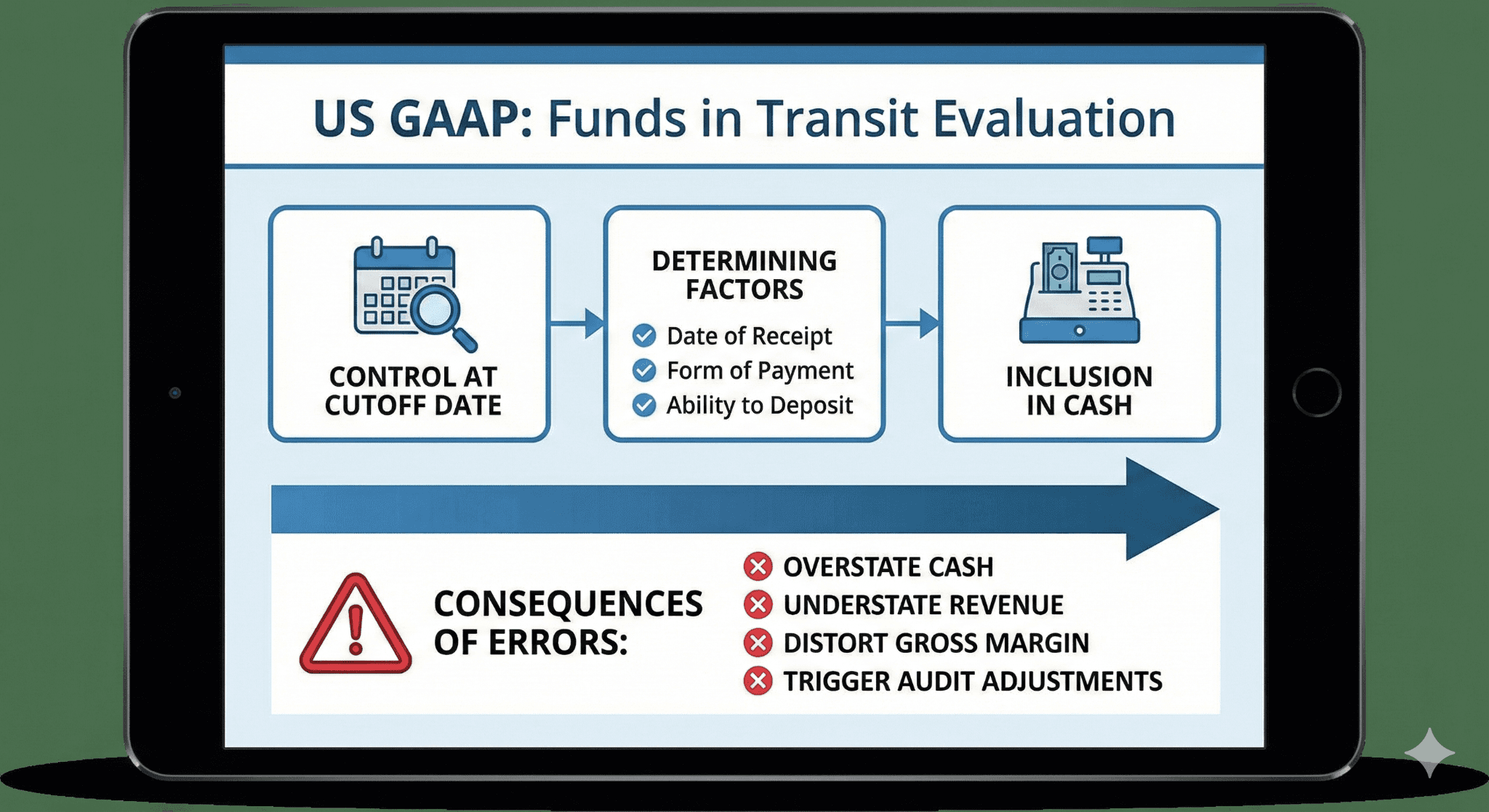
Under US GAAP, funds in transit must be evaluated based on control at the reporting cutoff. The date of receipt, the form of payment, and the ability to deposit determine inclusion in cash. Errors in this area can overstate cash, understate revenue, distort gross margin, or trigger audit adjustments.
This guide explains the GAAP framework, defines key terminology, and walks through practical case scenarios including physical checks, POS batches, merchant processors, ACH timing differences, intercompany transfers, and stale balances. It provides QuickBooks-Online centric workflows and documentation standards designed for controllers, accountants, and bookkeepers operating in SMB environments.
1. Understanding Undeposited Funds Under US GAAP
What Is Undeposited Funds?
Undeposited Funds in QuickBooks Online is a default current asset account used to temporarily hold customer payments before they are grouped into a bank deposit [1]. It is a clearing account. A clearing account temporarily accumulates transactions until they are finalized elsewhere.
This account exists to solve a workflow issue. Businesses often receive multiple payments and deposit them together. The bank records one deposit. QuickBooks Online must mirror that grouping to reconcile properly.
GAAP Perspective: ASC 305 – Cash and Cash Equivalents (Canonical)
Under ASC 305, cash includes:
Currency on hand
Demand deposits
Cash equivalents with short maturities
Funds in transit may qualify as cash if the entity has control over them at the reporting date.
Control means the company has possession or the ability to direct use of the funds. For example:
A physical check received and secured before cutoff
Cash counted and logged in a register drawer
ACH confirmation showing funds transferred before cutoff
If control does not exist at period-end, recognition must wait until the next period.
2. Month-End Cutoff: The Core Risk Area
Cutoff refers to ensuring transactions are recorded in the correct accounting period [5]. For Undeposited Funds, cutoff issues arise when receipt date and deposit date fall in different periods.
Controllers often focus on the bank statement date. That approach is incomplete. GAAP focuses on the date of receipt and control.
Timeline Illustration
Event | Date | Accounting Impact |
Payment received | January 30 | Record cash (Undeposited Funds) |
Deposit prepared | February 1 | Reclassify to bank |
Bank statement shows deposit | February 2 | Reconciling item |
Income is recognized when earned under accrual accounting. Cash is recognized when received if control exists.
3. Detailed Case Scenarios
Below are practical scenarios frequently encountered in SMB environments.
Case Scenario 1: Physical Check Received on Last Day of Month
Facts
Customer drops off check at 4:30 PM on March 31.
Accounting closes books at 6:00 PM.
Deposit occurs April 2.
Analysis
Control exists on March 31 because the company physically possesses the check. Under GAAP, cash increases March 31.
Journal Entry (March 31)
Dr Undeposited Funds
Cr Accounts Receivable
Documentation Required
Copy of check
Check log showing date received
Deposit slip dated April 2
Audit Risk if Omitted
Cash understated in March. Revenue may also be understated if tied to payment timing.
Case Scenario 2: Check Mailed March 31, Received April 3
Control does not exist on March 31. Recognition occurs April 3. Even if the customer dated the check March 31, the company cannot include it in March cash.
Case Scenario 3: POS Batch Close at Month-End
Retail businesses close POS batches nightly.
Facts
POS batch closed January 31 at 11:45 PM.
Credit card processor deposits February 2.
Under accrual accounting, revenue is recognized January 31 when sale occurs. Cash or receivable from the processor should also be recognized January 31 if settlement is probable and control is established.
Entry January 31
Dr Undeposited Funds or Processor Receivable
Cr Revenue
Documentation
POS batch report
Processor settlement summary
Case Scenario 4: Merchant Processor Deposits Net of Fees
Merchant processors such as Stripe or Square deposit net amounts [8].
Facts
Gross sales: $25,000
Fees: $750
Net deposit: $24,250
Deposit received April 2
If sales occurred March 31, revenue must be recorded gross in March.
March 31 Entry
Dr Undeposited Funds 25,000
Cr Revenue 25,000
April 2 Entry
Dr Bank 24,250
Dr Merchant Fees Expense 750
Cr Undeposited Funds 25,000
Recording only the net deposit understates revenue and distorts margins [9].
Case Scenario 5: ACH Initiated Before Cutoff, Settled After
Facts
Customer initiates ACH on June 30 at 5 PM.
Bank shows pending status.
Settlement clears July 1.
If ACH is irrevocable and the company has confirmation, inclusion in June cash may be appropriate. If not confirmed, defer to July.
Documentation must support the conclusion. Controllers should document policy for ACH timing.
Case Scenario 6: Cash Collected by Field Staff
Field technician collects $3,000 in cash on September 29.
Cash delivered to office October 2.
Control exists when a company employee collects cash if custody is secure and documented.
Required documentation:
Signed receipt to customer
Field collection log
Evidence of secure storage
Weak documentation may result in audit adjustment.
Case Scenario 7: Stale Undeposited Funds Balance
Year-end review shows $18,000 in Undeposited Funds dated 90 days prior.
Common causes:
Duplicate deposits from bank feed auto-match [3]
Deposit recorded without linked payment
Voided invoices not cleared
Clearing via lump-sum journal entry is inappropriate without investigation [2].
Case Scenario 8: Intercompany Funds in Transit
Parent company wires $100,000 December 31.
Subsidiary receives January 2.
Parent records reduction in cash December 31.
Subsidiary records increase when funds are received.
Consolidation requires elimination of in-transit differences.
4. Should You Accrue or Not?
Many practitioners ask whether funds in transit require accrual. The answer depends on the accounting basis.
Accrual Basis
Revenue recognized when earned. Cash timing separate. Undeposited Funds used only for clearing.
Cash Basis
Revenue recognized when payment was received. If the check is physically received before cutoff, revenue is recognized even if not deposited [10].
5. Documentation Requirements for Audit Readiness
Internal controls over cash remain a top audit focus .
Required Evidence at Month-End
Item | Purpose |
Undeposited Funds detail report | Identify open items |
Deposit log | Confirm receipt dates |
Bank reconciliation | Validate cleared deposits |
Processor statements | Support gross revenue |
Cutoff checklist | Formal management assertion |
6. Reconciling Undeposited Funds Separately from Bank
Many bookkeepers reconcile only the bank. That is insufficient.
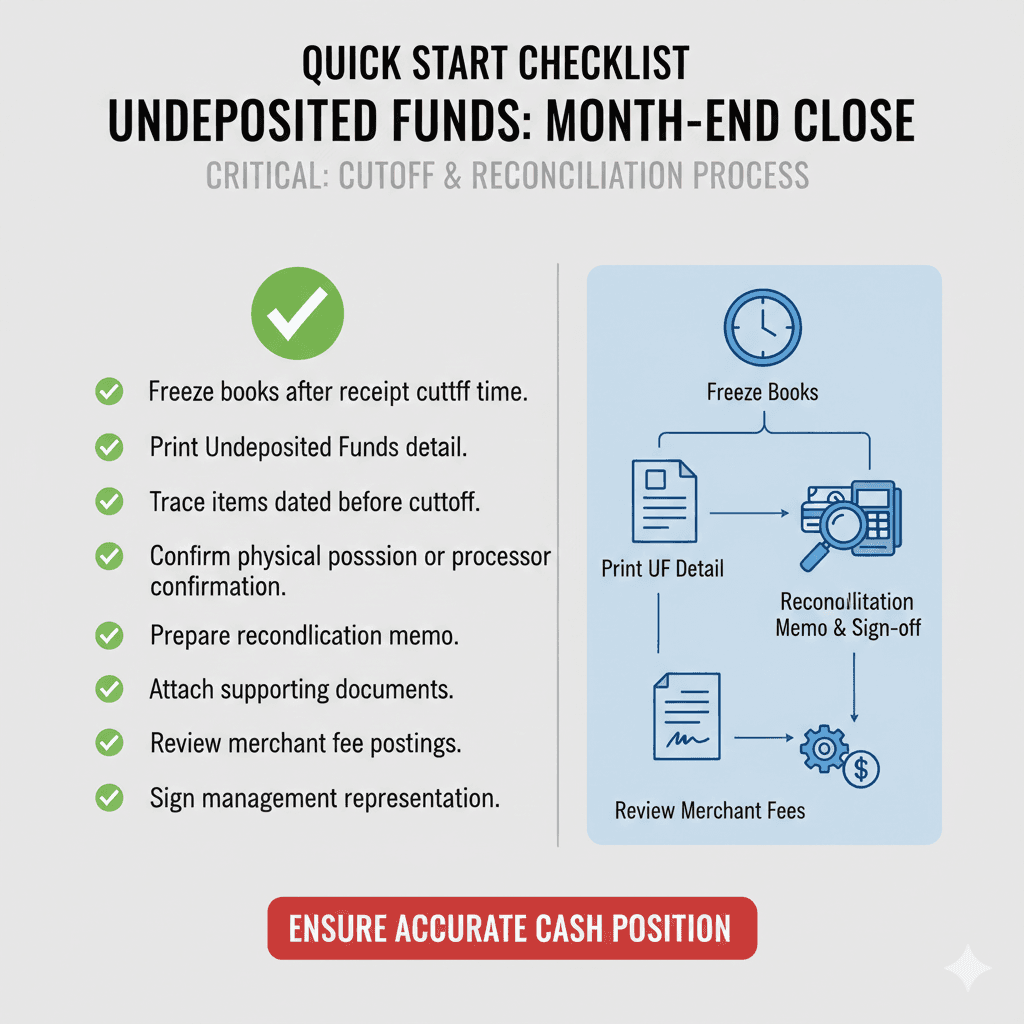
Monthly Undeposited Funds Review Process
Run General Ledger detail for Undeposited Funds.
Sort by transaction date.
Identify items older than 5–7 days.
Trace each to deposit transaction.
Investigate unmatched entries.
Undeposited Funds should normally clear within days in high-volume environments.
7. Internal Control Framework
Key Risks
Theft before deposit
Duplicate posting
Cutoff misstatement
Net revenue misclassification
Control Matrix
Risk | Preventive Control | Detective Control |
Theft | Dual custody on deposits | Surprise cash counts |
Duplicate deposit | Standard workflow | Weekly clearing account review |
Cutoff errors | Written policy | Month-end certification |
Net recording | Gross revenue policy | Margin analytics review |
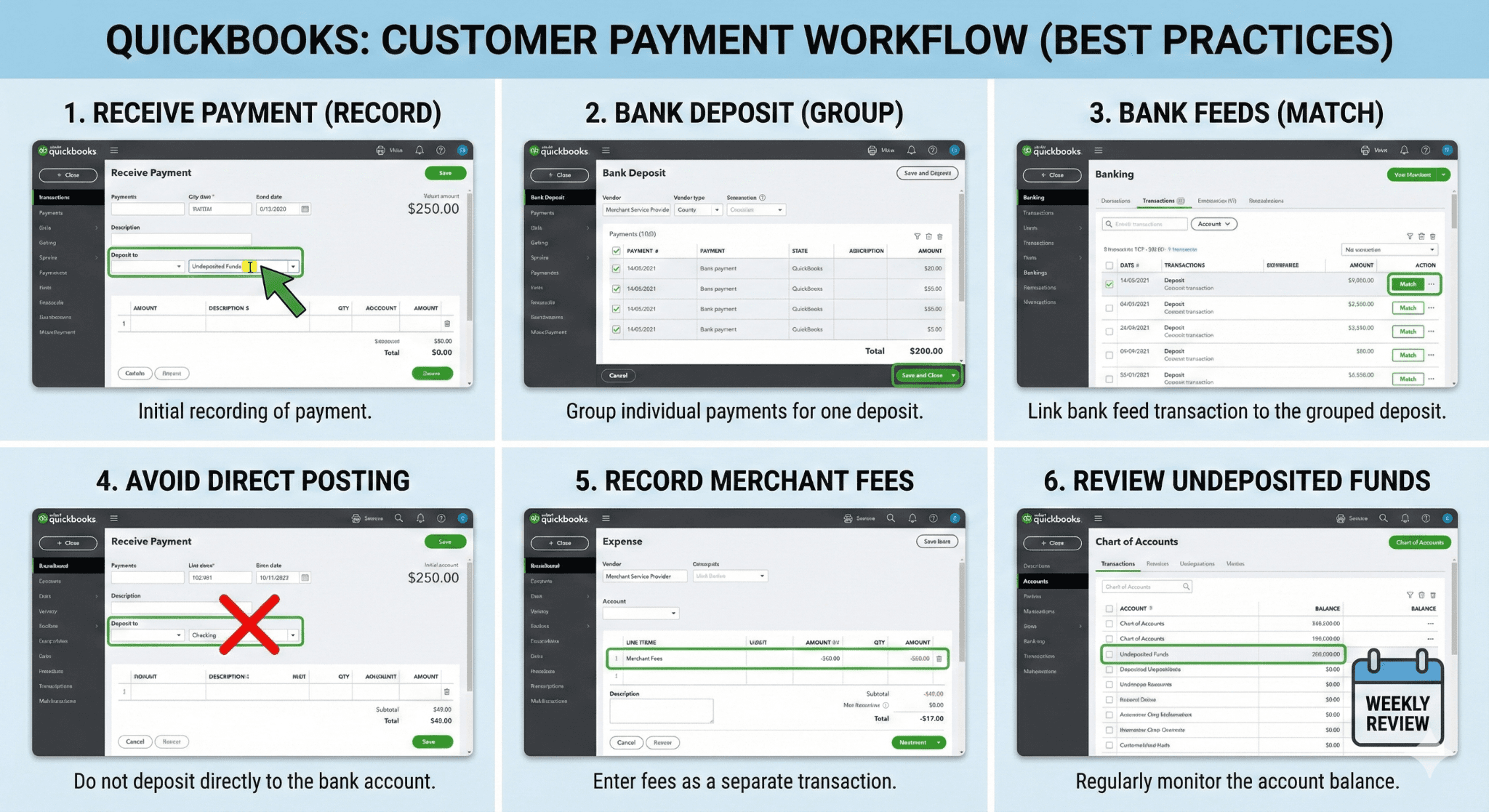
8. QuickBooks Online Workflow: Best Practices
Record customer payments to Undeposited Funds [1].
Use the “Bank Deposit” function to group payments.
Match bank feed to grouped deposit.
Avoid posting payments directly to bank.
Record merchant fees separately.
Review Undeposited Funds weekly.
9. Advanced Year-End Example
A mid-market distributor had:
$72,000 checks received December 30
$15,000 POS batch December 31
$9,000 cash collected by sales rep December 29
Deposits made January 2.
Total in transit: $96,000.
Controller initially excluded these amounts from December cash. Audit adjustment increased cash by 8 percent and corrected working capital ratio.
Documentation supported inclusion.
10. Risks and Consequences
Error | Financial Statement Impact |
Failure to record in transit funds | Understated cash |
Duplicate deposit | Overstated cash |
Net revenue recording | Understated revenue |
Journal entry cleanup | Weak audit trail |
Cash misstatements directly affect liquidity ratios and debt covenant compliance.
11. Quick Start Month-End Checklist
12. Frequently Asked Questions
1. Should Undeposited Funds ever carry a large balance?
Only temporarily. Persistent balances indicate process breakdown.
2. Is Undeposited Funds considered restricted cash?
No. It is unrestricted if control exists.
3. Can I bypass Undeposited Funds for simplicity?
Not recommended if deposits group multiple payments.
4. How often should it be reconciled?
Weekly for high-volume entities. Monthly at minimum.
5. Are merchant fees operating expenses?
Yes. They are typically classified as selling expenses.
Glossary
Clearing Account: Temporary account used until final classification.
Cutoff: Assignment of transactions to correct reporting period.
Funds in Transit: Cash received but not yet reflected in bank statement.
Gross Revenue: Total sales before deductions.
Control: Ability to direct use of funds.
Conclusion
Undeposited Funds are operationally simple but financially sensitive. Under US GAAP, funds in transit require judgment grounded in control and cutoff principles. Controllers must implement formal review procedures, document receipt timing, and reconcile clearing accounts independently of the bank.
In SMB environments using QuickBooks Online, the difference between a clean month-end close and a material audit adjustment often lies in this single account.
Strong process discipline transforms Undeposited Funds from a nuisance into a reliable component of internal control.